
Criminal Court Records in Jefferson Davis County
A criminal court record is the case file the court opens once formal charges are filed against a defendant. It is not the arrest report and it is not the jail log. It is the running account of the prosecution, kept by the clerk who serves that court. In Jefferson Davis County the Circuit Clerk, Clint W. Langley, receives and files indictments, motions, and related papers in felony cases, issues process such as summonses and subpoenas, and keeps the records of judgments and executions. The file grows as the case moves, and every order, plea, and hearing becomes part of it.
Two trial levels produce most criminal records here. The 15th Circuit Court is the felony trial court for Jefferson Davis County, and it sits alongside Lamar, Lawrence, Marion, and Pearl River Counties in the same district. Its judges are Hon. Prentiss G. Harrell, Hon. Richelle Lumpkin, and Hon. Brad Touchstone. Felony cases do not begin in Circuit Court, though. They start in Justice Court with an initial appearance and a sworn affidavit, then move up by indictment. Justice Court and Prentiss Municipal Court keep the records for misdemeanors, county ordinance violations, and city offenses that never reach the felony track.
District Attorney Hal Kittrell prosecutes felonies for the 15th Circuit, and a small number of the most serious matters are taken up instead by federal prosecutors. The lead-in to that federal track runs through the U.S. Attorney's Office for the Southern District of Mississippi, which covers Jefferson Davis County.
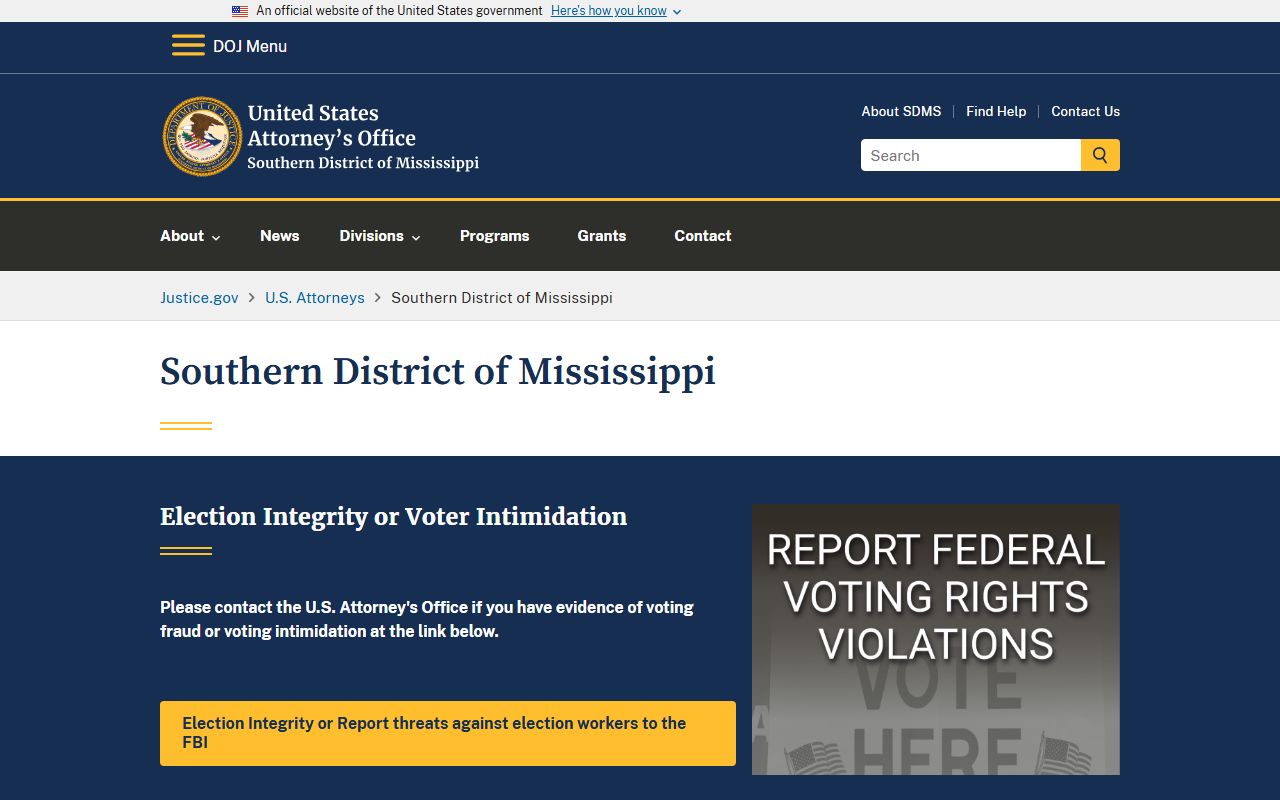
A case handled in federal court will not appear in the county Circuit Court file, so a complete criminal-record search sometimes means checking both the state and federal systems for the same name.
How to Search Jefferson Davis County Criminal Court Records
Circuit Court criminal cases are filed and tracked through Mississippi Electronic Courts, the statewide system the public reaches through PAMEC. The county does not run a separate branded portal, so PAMEC is the front door for electronic felony files. A free account with a login is required before case data opens, and the username and password fields have set length limits during sign-up. Older files that predate electronic filing may not appear online at all.
- Create or sign in to a Public Access to Mississippi Electronic Courts account, which requires a username and password.
- Search by the defendant's name or by the case number if you already have it.
- Narrow the results by court, case type, and filing date to find the right Circuit Court matter.
- Open the case to read the docket entries, the charges, and the disposition.
- Request a certified copy from the Circuit Clerk when a court-ready document is needed.
When a record cannot be found online, the office that holds the file is the next stop. Call the Circuit Clerk at 601-792-4231 for felony files, Justice Court at 601-792-5129 for misdemeanor and initial-appearance matters, and Prentiss Municipal Court through Town Hall at 601-792-5196 for city offenses. A statewide name-based criminal history is held by state law-enforcement agencies rather than the county clerk, and those checks follow their own access rules.
Stages of a Criminal Case
A criminal case moves through fixed stages, and each one leaves its own mark on the record. A felony begins with an arrest, then a quick first hearing. Justice Court judges in Jefferson Davis County hold sessions at the jail three times each week so every arrestee gets an initial appearance within three days of arrest. From there the case can be bound over to a grand jury, returned as an indictment, and set for arraignment in Circuit Court. The docket shows the date and outcome of each step.
Case flow: Charges Filed › Arraignment › Pretrial / Motions › Plea or Trial › Disposition › Sentencing
| Stage | What Happens |
|---|---|
| Arraignment | The defendant is formally told the charges in the indictment or information and enters a plea of guilty or not guilty. |
| Pretrial / Motions | Lawyers file written requests, set bond conditions, exchange evidence, and argue motions that can narrow or end the case. |
| Plea or Trial | The case ends in a negotiated plea or moves to a jury trial, where most Circuit Court matters are decided by juries. |
| Sentencing | After a guilty plea or verdict, the judge orders the punishment, which may include prison, probation, fines, and restitution. |
Local cases show how these stages read on paper. In March 2026, regional outlet WDAM reported that trial dates were set for two former Jefferson Davis County officials who had been indicted and then waived arraignment, with one trial set for September in Circuit Court on charges of hindering prosecution and tampering with physical evidence. That local trial-date report tracks the same path any felony file follows.
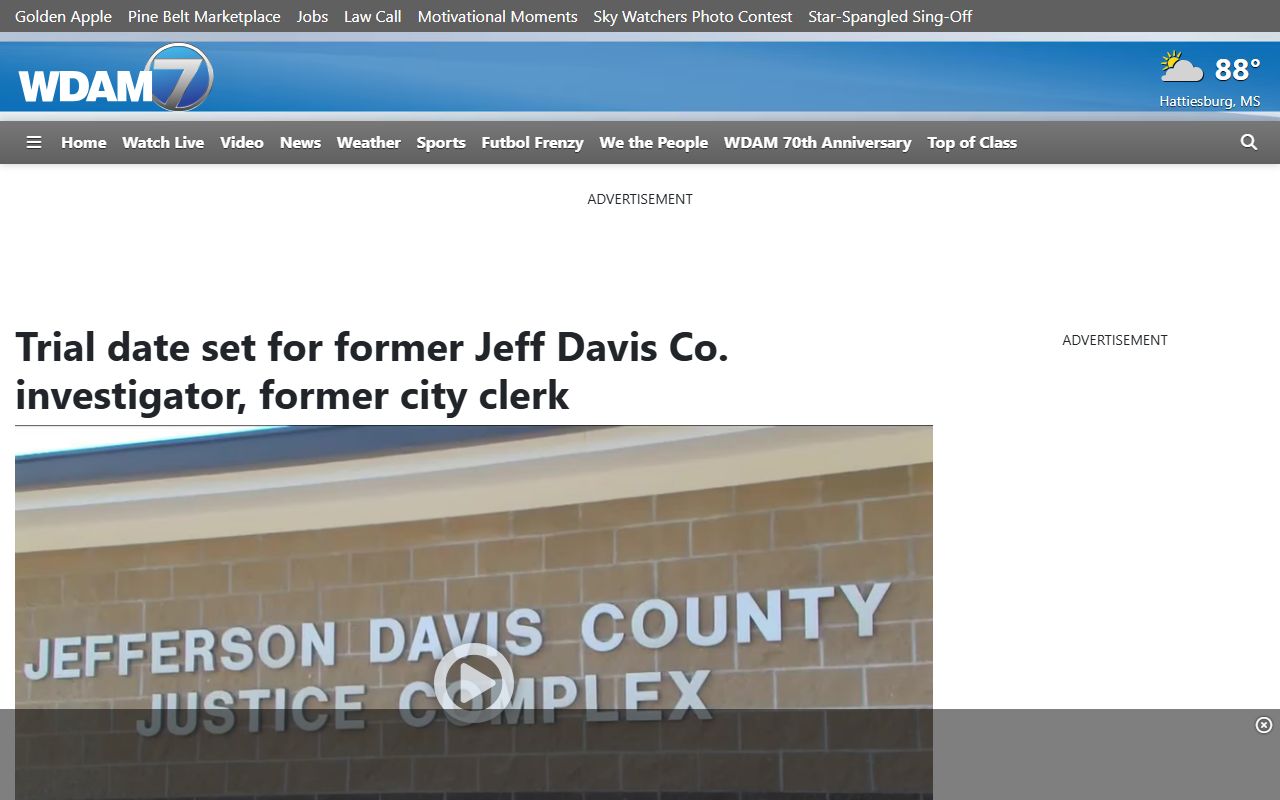
The story names the indictment, the waived arraignment, the charges, and the trial setting, which are the exact docket events a Circuit Court criminal file records for every defendant.
What a Jefferson Davis County Criminal Court Record Shows
A criminal case file is built from many small fields, and reading it well means knowing what each one carries. The case number ties every filing together. Party names appear as the State against the named defendant. The docket lists each motion, order, hearing, and continuance in date order, while the disposition and sentence sit near the end. Financial fields track fines, court costs, restitution, and any bond. The same file can also carry status flags such as a bench warrant issued, a capias pending, or a case marked sealed.
| Field | What It Shows |
|---|---|
| Case Number | The unique identifier the court assigns, used to pull every document in the file. |
| Defendant | The person charged, listed as the respondent to the State's prosecution. |
| Charges | Each offense as filed, tied to a Mississippi statute, with its severity level. |
| Plea | The defendant's formal answer, such as guilty, not guilty, or no contest. |
| Disposition | The current or final outcome of each charge, from dismissal to conviction. |
| Sentence | The punishment ordered after a conviction, with any probation or restitution terms. |
Counsel of record also appears in the file. Jefferson Davis County lists Robert Benton Evans and Andre F. Wallace among its public defenders, and John Allen Buffington as county prosecutor. A close look at the docket, not just the cover sheet, is the only reliable way to learn how a case actually ended.
Charges vs. Convictions
Being charged is not the same as being convicted, and a criminal court record holds both kinds of entries. A charge is an accusation that opens the case. A conviction is the finding of guilt that can follow a plea or a trial. Many files show charges that were later dropped, dismissed, reduced, or that ended in an acquittal. Reading the disposition for each separate charge is the only way to tell which accusations stuck and which fell away.
| Charge | Conviction | |
|---|---|---|
| Stage | Accusation | Verdict or plea |
| Burden of Proof | Probable cause | Beyond reasonable doubt |
| Public Record | Yes | Yes |
A first-time, non-violent defendant may also avoid a conviction through the 15th Circuit District Attorney's Pretrial Diversion Program. The program is an alternative to prosecution that lets a qualifying person complete set conditions and keep a criminal record clear. The charges still appear in the file, but the outcome differs from a conviction. The booking side of the arrest and the prosecutor's filing choices are covered in more depth in the Jefferson Davis County arrest records and court charges overview.
Reading Dispositions and Sentences
The disposition is the heart of a criminal record. It states what happened to each charge. Common entries include guilty, not guilty, dismissed, nolle prosequi, and no contest, which is sometimes written as nolo contendere. A deferred or nonadjudicated outcome means the court held off on a formal conviction while the defendant met certain terms. Each charge can carry its own disposition, so one file may show a conviction on one count and a dismissal on another.
The sentence follows a conviction and spells out the punishment. It can combine a prison or jail term, a suspended term, probation, fines, court costs, and restitution to a victim. Probation is a supervised sentence served in the community rather than behind bars. Restitution is money ordered to repay a victim's loss. When the sentence is hard to read, the Circuit Clerk can confirm what the final order says and provide a certified copy.
Sealed vs. Expunged Records
Not every criminal record stays open forever. Mississippi law lets some cases be sealed or expunged, and the two are not the same. A sealed record is hidden from general public view but still exists for limited official use. An expunged record is treated as if it never happened, and public systems should no longer disclose it as an open matter. Section 99-19-71 of the Mississippi Code is the core expungement statute, and it controls which dismissed charges, misdemeanors, and qualifying felonies can come off the public file.
| Sealed | Expunged | |
|---|---|---|
| Visibility | Hidden from public | Destroyed / treated as never existed |
| Law Enforcement | Limited access | Very limited |
| Eligibility | By statute or court order under Mississippi law | Qualifying dismissals, misdemeanors, and limited felonies under Section 99-19-71 |
An expungement starts in the court where the case was handled. A person seeking one should gather the court name, case number, charge, disposition, the date all terms were completed, and any costs still owed, then file a petition with the right clerk. A Jefferson Davis County expungement form and fee were not published in county sources, so call the Circuit Clerk, Justice Court, or Prentiss Municipal Court depending on where the case sits.
Public Access to Criminal Court Records
Criminal case files are public in Mississippi unless a statute, court rule, or court order closes them. The practical rule for Jefferson Davis County is to ask the office that keeps the file. Felony files route to the Circuit Clerk, misdemeanor and initial-appearance files to Justice Court, and city cases to Prentiss Municipal Court. If a record is not online, a written request to the holding office is the standard path, and search, copy, and certification costs may apply.
Key Statutes:
Mississippi Code Title 25, Chapter 61 - the Public Records Act keeps government records open for inspection unless a specific exception applies.
Mississippi Code § 99-19-71 - sets expungement eligibility for certain dismissed charges, misdemeanors, and qualifying felonies.
Mississippi Code § 43-21-251 - treats Youth Court records as a special, confidential record category.
Background Check Considerations
A casual record lookup and a formal background check are not the same thing. Pulling a single case from PAMEC or a clerk's counter answers a narrow question about one matter. A background check used to decide on a job, an apartment, credit, or insurance falls under the federal Fair Credit Reporting Act and must run through a regulated consumer reporting agency. County court files can be incomplete or out of date, so a court-purpose record should always be verified with the originating clerk.
Important: This site is not a consumer reporting agency under the Fair Credit Reporting Act, and its information cannot be used for credit, employment, tenant, or insurance screening.
Restricted Criminal Court Records in Jefferson Davis County
Some criminal matters stay closed to the public no matter how a search is run. Youth Court files for delinquency, children in need of supervision, and abuse or neglect are confidential and are not searchable by name. Sealed and expunged cases drop out of public view by law or court order. Records tied to an ongoing investigation, sealed search warrants, and personal identifiers such as Social Security and financial account numbers are also withheld or redacted.
When a case cannot be found, that does not always mean it never existed. It may be sealed, expunged, juvenile, or simply old enough to sit only in paper files. The fastest way to confirm a record's status is to call the clerk for the court that handled it. The same offices that keep open files also know which records the law keeps private.